Category Archives: Children and Youth

Enemies of the poor

By Zubeida Mustafa

EIGHT years ago, a young woman from Khairo Dero (Larkana district) was so touched by the plight of her people that she decided to work for their uplift.

She had been fortunate to receive a privileged education abroad, was doing a lucrative job and had all that one could wish for in life. Today, she has renounced these privileges to work for her people. .

Thus Naween Mangi set out on her journey of creating a model village for development in Khairo Dero. Continue reading Enemies of the poor

Keeping them illiterate

By Zubeida Mustafa

Going by the number of education policies announced in Pakistan since 1947, the volume of reports produced by commissions on this issue of direct concern to human development and the statements issued by government dignitaries pledging their commitment to universalising education, one would have thought that by now  Pakistan must be heading the world  education league.

What is the reality? The UNDP, which compiles the Human Development Index using schooling as one of the criteria, tells us another story. In its 2015 report, Pakistan is categorised as a Low Human Development country and ranks 147th out of 188 states. The mean years of schooling for children is 4.7 years and only a third of the population above 25 has had some secondary schooling. Continue reading Keeping them illiterate

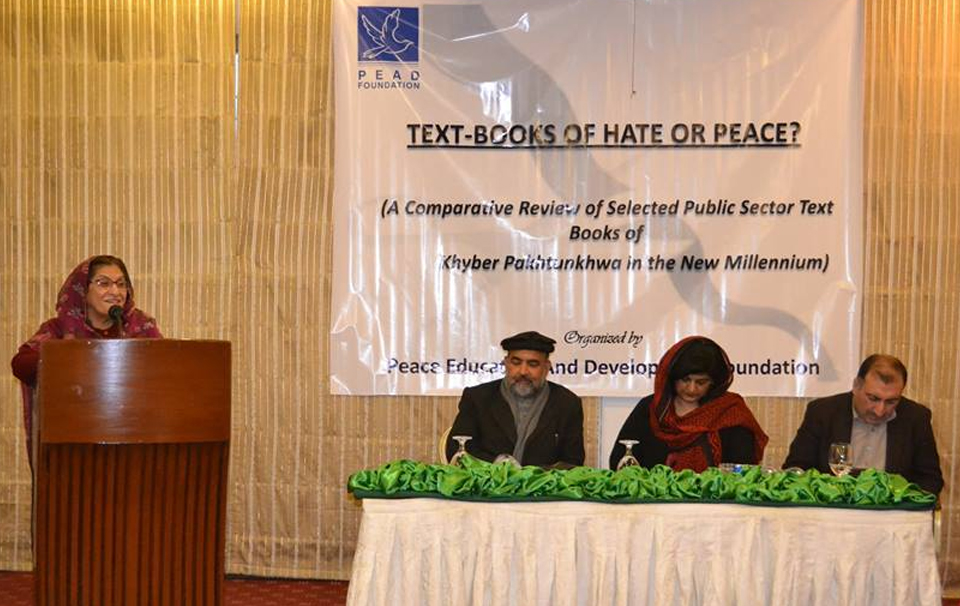
Textbooks of hate

Peshawar: Launching of Textbooks of Hate or Peace? on 11 Feb 2016

By Zubeida Mustafa

PAULO Freire, the Brazilian educator and author of Pedagogy of the Oppressed, said education should aim at teaching students to think critically. They should work with the teacher in creating knowledge.

Freire believed that students should do a lot of “problem-posing” and then seek answers through their own experience and thought processes to discover the route to change.

Can we hope to achieve this change through the kind of textbooks used in our public-sector schools? For decades, critics have mourned the dismal state of textbooks in Pakistan. But no one has batted an eyelid. Continue reading Textbooks of hate

A Global Conglomerate of Oppression

Noor Zaheer

By

The pronounced lack of interest in the public health system in Pakistan is not difficult to explain. Public opinion in a country as stratified and uninformed as ours, is created and moulded by the so-called privileged classes, comprising those members of society who have the means to pay for private health care. Hence they are not affected by the abysmal state of health care in the public sector on which the poor depend.

The general attitude is: what is the role of the poor in our society? They are useful only for domestic labour in the homes of the rich or for menial work in public places and factories. And, of course, to vote at election time. A higher birth rate among the impoverished ensures there is never any shortage in the labour force. If they fall sick, they are easily replaced. With limited skills and training, none are really indispensable. Continue reading A Global Conglomerate of Oppression

After freedom what?

Sohail Fida-- a year after he was released
Sohail Fida– a year after he was released

By Zubeida Mustafa

FOUR years ago, on a leap day, a young man of 28 walked out of Haripur jail to his freedom. Now when he looks back at this great event in his life, he describes his feelings on the occasion as ‘confusing’. It felt surreal, he said to me, as he looked back to that day. “I was asking myself, ‘Is this really happening to me?’”

Sohail Fida was hauled into prison in 2000 when he was only 16 years. Allegedly false charges of murder were brought against him and a confession extracted by torture.

Despite his incarceration for 12 years — five of them on death row — Sohail did not lose hope. His story is one of grit and courage. It is a story that inspires. Continue reading After freedom what?