Category Archives: Children and Youth

Language Discrimination in Pakistan Harms Women and Indigenous Culture

By Zubeida Mustafa

Asifa, 12, lives in Karachi, the port city in southern Pakistan. She is a child of the lesser gods. That means that she is malnourished and falls ill frequently. Her home is a modest two-room house with no running water in which her family of eight lives. She is fortunate to go to a better school than the public sector institutions many of her friends and neighbors attend – that is, if they go to school at all. Being the first generation school-goer in her family, Asifa’s is not the carefree existence a child deserves. Her parents have invested a lot in her to provide her education, and have pinned all their hopes in her future.

Will Asifa be able to lead her family out of poverty? Most unlikely. Continue reading Language Discrimination in Pakistan Harms Women and Indigenous Culture
Revisiting the Women’s Movement

By Zubeida Mustafa

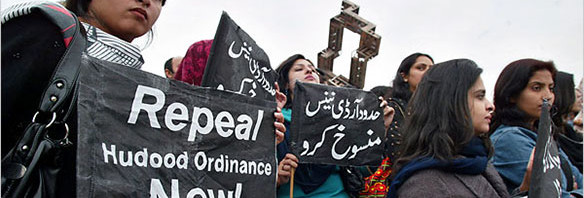
PAKISTAN is a dichotomous world. This is a country that has produced a woman prime minister – the first to be elected in a Muslim state. Its predominantly male parliament – the lower house – unanimously adopted a bill against domestic violence four years ago, but it failed to become law because the upper house refused to take it up. Its academia are now overflowing with female students – many of them in hijab. But this is also a country where women are murdered for marrying a man of their own choice, where little girls like Malala are shot in the head for going to school and where law makers defend their ‘right’ to bury women alive in the name of honour and refuse to condemn a colleague who has had his daughter killed for wanting a divorce. Continue reading Revisiting the Women’s Movement

Rethinking medium

By Zubeida Mustafa

LAST week there was something to celebrate — rare in these troubled times. One of our eminent scholars, Dr Tariq Rahman, dean of the School of Education at the Beaconhouse National University, Lahore, was awarded a DLitt degree by the University of Sheffield, UK, for his work on language, art, culture and social developments that was assessed to qualify him on merit for this honour. In Europe less than 1pc of faculty gets a DLitt in the social sciences.

This achievement should do Pakistan proud. Given the state of our education, any academic whose work wins recognition, especially internationally, deserves to be acknowledged. This should be treated as an occasion for us to revisit his work and scholarship.

It is also important for our policymakers and educationists to read some of Dr Rahman’s 18 books embodying his knowledge and research. They will realise where they have gone wrong. Dr Rahman is a prolific writer and his works are eye-openers especially regarding language in the educational, social, cultural and political context in Pakistan. Continue reading Rethinking medium

Battle of ideas

By Zubeida Mustafa

AS it has gathered steam, the Children’s Literature Festival (CLF) — a unique event in Pakistan — has collected around itself a band of devoted supporters sharing the ideals of the founders. A key objective of the festival is to encourage children to read books so that they develop the faculty of critical thinking. Recently Karachi hosted the 11th CLF and on this occasion the question asked was what purpose books would serve in these testing times. Ahmad Shah, the president of the Karachi Arts Council, who generously opened up the KAC’s premises for the children of the city, had the answer.

The basic aim of education should be to change the mindset of people, he said. This can be done by promoting the reading of books — a habit which gives exposure to a variety of opinions and enlightens the readers in the process. Continue reading Battle of ideas

Magic of a teacher

By Zubeida Mustafa
A WITTY quote runs, “Doctors bury their mistakes. Lawyers hang them. But journalists put theirs on the front page.” I would add, “And teachers exhibit theirs for generations to come.”

Take the case of Pakistan where the malaise in education runs deep. It began decades ago and has increased as poor education for one generation has ensured a worse batch of teachers for the next.

Mercifully, this flaw has now come to be recognised and an effort is under way to rectify the wrongs of the past. The focus has shifted to teachers. All schools worth their salt are now providing for the training of their teachers on an ongoing basis. Workshops and seminars are held regularly. The concept of lifelong education is catching on. Continue reading Magic of a teacher