EIGHT years ago, a young woman from Khairo Dero (Larkana district) was so touched by the plight of her people that she decided to work for their uplift.
She had been fortunate to receive a privileged education abroad, was doing a lucrative job and had all that one could wish for in life. Today, she has renounced these privileges to work for her people. .
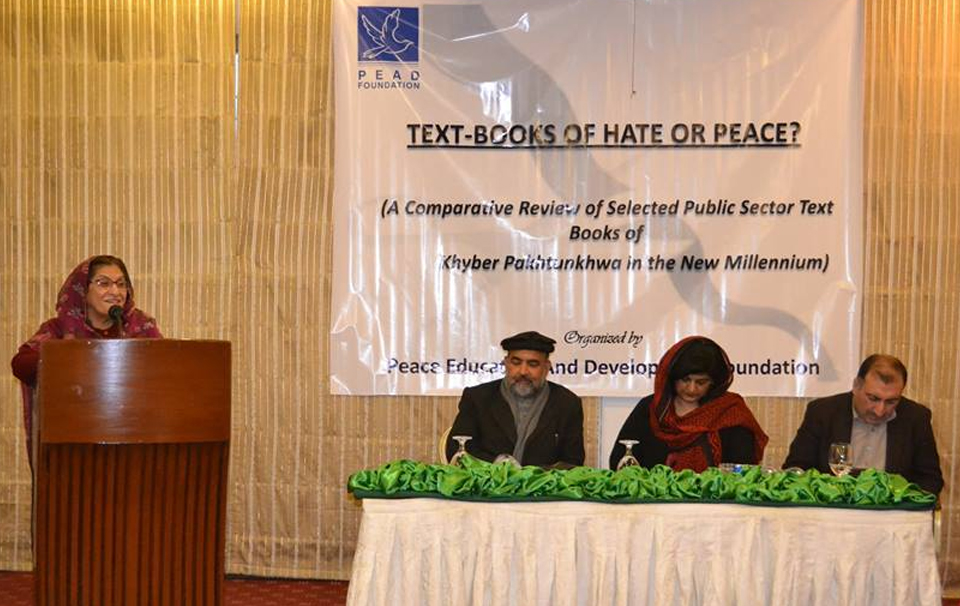
Peshawar: Launching of Textbooks of Hate or Peace? on 11 Feb 2016
By Zubeida Mustafa
PAULO Freire, the Brazilian educator and author of Pedagogy of the Oppressed, said education should aim at teaching students to think critically. They should work with the teacher in creating knowledge.
Freire believed that students should do a lot of “problem-posing” and then seek answers through their own experience and thought processes to discover the route to change.
Can we hope to achieve this change through the kind of textbooks used in our public-sector schools? For decades, critics have mourned the dismal state of textbooks in Pakistan. But no one has batted an eyelid. Continue reading Textbooks of hate→
LAST week Karachi hosted the Teachers’ Literature Festival — an innovative experiment — to introduce an alternative discourse in education.
Here a lively session on language in learning was held. That teachers should be interested in this is understandable. The issue impacts their work directly. The fact is that the language used in education determines the learning output of students. Their poor performance in independent assessment tests such as ASER actually reflects on the quality of pedagogy they receive. That in turn is a clear measure of our teachers’ skills and professional standards. Continue reading Language myths→
JAN 22 was Perween Rahman’s birthday. Had she escaped the assassin’s cruel bullets she would have turned 59. But that was not to be and this devoted social worker, a friend of the poor, was snatched away from us three years ago on March 13, 2013.
Not that she has receded into oblivion. The poor are not ungrateful. Nor have those who feared her mended their ways. OPP-RTI, the organisation she headed, wanted to observe Perween’s birthday and celebrate her life and achievements. Such events help imprint on the public memory the work of selfless and lovable personalities who have made an impact on the lives of those they worked for. Thus alone will many Perweens be born. This is absolutely necessary if this society is to be saved from the avarice of the selfish. Continue reading Unsilenced voice→
Every journalist has a story to tell. Teenaz Javat, by blood Indian, by bond Pakistani, by choice Canadian as she describes herself, and by profession a journalist, also has a story to tell. I ask her which story she wrote that gave her a sense of achievement. She speaks of ‘Turning Point,’ a story on domestic violence in the South Asian community in Toronto .
This was co-produced by her for CBC Radio. She was the lead researcher. The programme discussed several high-profile domestic murders of South Asian women. Her programme created quite a stir and it led to the Toronto police convening a conference to discuss violence in South Asian communities. Teenaz says, “I was really happy that something I did on radio had made such a big impact on the community.” She even won the prestigious Ontario Premier’s Award in 2011 for the story.
Good journalists must be rooted in the community about which they report. A media person who does not know and understand the men and women who are central to her stories can never be the best. Always aware of this truism, I would often marvel at a young woman who I met in my colleague’s office soon after she had joined Dawn in 1994, where I worked. Continue reading Turning point→