Category Archives: Education

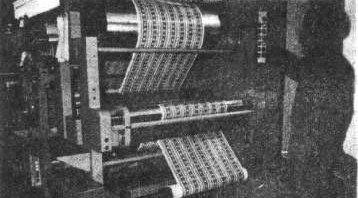
Woes of the printing industry: Need for duty cuts, cheap newsprint, incentives

By Zubeida Mustafa

THE TWO major problems facing the printing industry in Pakistan are the high cost of production and the poor quality of service provided. Identifying these two factors which determine the state of the industry today, Mr Ahmad Mirza Jamil, the outgoing Chairman of the Pakistan Association of Printing and Graphic Arts Industry (PAPGAI) points out that if the industry is surviving in the country it is because printers are operating in a seller’s market. The dismally low literacy rate, the poor reading habits of the people and the scarcity of low-priced books and literature are key indicators of the state of the publishing and printing industries in Pakistan.

It is not surprising to find these industries in a poor state. In a society where education is at a discount, the elements which go into the making of education also tend to be ignored. As compared with the publishing sector, printing is better off because it c to multifarious needs other than those of the publishers and stationers. The printer gets a substantial part of his business from the orders he receives for the printing of labels, cartons, pharmaceutical literature (which the majority of consumers cannot read), invitation and greeting cards and calendars. There is urgent need to look into the Continue reading Woes of the printing industry: Need for duty cuts, cheap newsprint, incentives

Publishing industry’s travail : Book production a high risk business

By Zubeida Mustafa

 BOOK PUBLISHING is a high risk business in Pakistan, says Mr Shams Quraeshi of Mackwin & Co. who has been in the book trade since 1947. Returns are slow in coming, hence not many people with capital to spare wish to invest in it. They would rather opt for an industry with quicker and guaranteed returns.

Even banks regard books as poor risk. Thus one can get a bank loan of Rs 80,000. against paper reams worth Rs 100,000. But as soon as the paper is converted into a book, no bank is prepared to accept it as security to advance a loan.

Malik Noorani, whose Maktabe-i- Daniyal has published the works of Faiz, Mushtaq Yusufi and Josh, considers himself to be lucky if he breaks even. “You have to be an entrepreneur, gambler and philanthropist to be a publisher. You also need a Qarun ka khazana and Ayub ka sabr,” sums up Mr Noorani, “I do not have the first, though I have the second.”

He admits that he manages to sell off all the books he publishes because he prices them abnormally low, which would not be feasible were he not subsidising his publications from his income from the sale of law books through the Pakistan Law House, which he runs at the Pakistan Chowk. In law books it is a seller’s market, Continue reading Publishing industry’s travail : Book production a high risk business

Publishing industry’s travail: Narrow market, poor technology inhibit expansion

By Zubeida Mustafa

IN 1978, the year for which full statistics are available, 642,000 titles were published in the world. Out of these Pakistan’s share was a meagre 1,317 titles, whereas Japan and West Germany, with smaller population produced over 43,000 and 50,000 titles respectively.

This projects a rather gloomy picture of the state of our book world. Things are said to Continue reading Publishing industry’s travail: Narrow market, poor technology inhibit expansion

Reading habits in children

By Zubeida Mustafa

THE ten-year-old drones on as he pausesat the end of each paragraph glancingfurtively at his teacherfor the eagerly awaited signal to stop.

The four-i ear-old enthusiastically turns the pages of his picture book as be concentrates on whatthe illustrations are trying to convey.

Although the older child is doingwhat would technically be called the act 0f reading recognizing the printed letter and decodingit into pronounceable words it is the four-year-old who isactually doing more readingfor reading is a complete actof communication which correspondsto the act of writing in thesense that it involves responseand feedback from the reader.

Despite the advantages of reinterpretationand retrospectionwhich reading offers, many people are not inclined to take upa book purely for recreation. They would much prefer the TV screen. Surprising thoughit might appear this is the case,to a greater extent, in the developed countries where literacyis universal and where onewould expect to take the readinghabit for granted. Thus it is estimated that in France 53 percent, in Netherlands 40 per centand in Hungary 39 per cent ofthe adults do not read books.But in Bangladesh where literacyis low barelya tenth of the literate people are non-readers, since those whoare literate are highly motivated. Continue reading Reading habits in children

Memories of a great scholar

By Zuhair Siddiqi, Viewpoint, September, 1977

geust-contDr. Wahid Mirza died in Lahore on September 5.

MOHAMMAD WAHID MIRZA was already in his late seventies, and slowly wearing away, when the country observed the 700th death anniversary of his beau ideal, Amir Khusrau, earlier this year. For nearly forty years, Dr. Mirza had been a distinguished figure in the world of Oriental learning. But outside the limited circle of Orientalists, he was not much known — thanks largely to his own retiring disposition and his inherent dislike of self-projection. During the last year of his life, however, his valuable work on Amir Khusrau brought him much wider recognition among the lay intelligentsia. In their search for authentic material on the fascinating character and amazing achievements of that great savant, writers and journalists inevitably had to turn to Dr.Wahid Mirza’s classic contribution, and many of them acknowledged him as one of the greatest living authorities on the subject. The National Book Foundation published a new edition of his Life and Works of Amir Khusrau, which has held the field as a practically indispensable work of reference ever since it was first published in 1935. And at the request of the Foundation,he produced within a few days, in spite of his old age and failing health, an English translation of Khusrau’s Khazain-ul-Futuh — a short history of the reign of Alauddin Khilji. As wider recognition, and fresh bouquets of tribute came to Dr. Mirza during the last year of his life one was reminded of the touching lines of Robert Blair : Continue reading Memories of a great scholar