Category Archives: Human Rights

Vulnerable, exploited, oppressed: Pakistan’s labour force


NewslineBy Zubeida Mustafa

PILER is one of those rare not-for-profit organisations in this age of neoliberalism that continues to do research, collect information and create awareness on taboo labour issues. More than that, for 34 years PILER has championed the cause of the labour movement in Pakistan though the tragedy is there are few who now care about what is happening to our workers on whom depends the success of our economy and the well-being of the people.

PILER has published five reports on the ‘Status of Labour Rights in Pakistan.’ The 2015 report was released recently and would come as an eye-opener for those who read it. The earlier reports covered the years 2007, 2010, 2011 and 2014. They have all been translated into Urdu by Abdus Salam Salami, a development journalist. Continue reading Vulnerable, exploited, oppressed: Pakistan’s labour force

Why we failed


imagesBy Zubeida Mustafa

QANDEEL Baloch’s horrific murder in the name of ‘honour’ is testimony to the failure of the women’s movement to overturn patriarchy in Pakistan. Against the backdrop of the spate of anti-women violence, comes a report by Dr Rubina Saigol written for the Friedrich-Ebert-Stiftung, a German foundation. Titled Feminism and the Women’s Movement in Pakistan: Actors, Debates and Strategies, this excellent document should provide much food for thought.

The author, an eminent sociologist, touches the heart of the issue — especially in cases like Qandeel’s — when she points out that there are “silences” (neglected subjects) that surround questions of family and sexuality, the mainstay of patriarchy and women’s subjugation. These have generally not been addressed by the women’s movement and she recommends that they should be. Continue reading Why we failed

What is LSBE?

2

By Zubeida Mustafa

I WAS first introduced to the term ‘life skills-based education’ at a forum of the Indus Resource Centre a few weeks ago. The term was used freely but it was not elucidated sufficiently, at least not for novices like me.

The IRC, which is doing very good work by promoting education in Sindh, had just completed its Reproductive Health through Girls’ Education project and we had gathered for an independent assessment. This was basically a population venture funded by the David and Lucile Packard Foundation but fitted into IRC’s agenda since it sought to change the mindset of girls vis-à-vis reproductive health issues. This was expected to impact on the galloping population growth rate of the country — one of the most serious concerns of the day. Continue reading What is LSBE?

Keeping them illiterate

By Zubeida Mustafa

Going by the number of education policies announced in Pakistan since 1947, the volume of reports produced by commissions on this issue of direct concern to human development and the statements issued by government dignitaries pledging their commitment to universalising education, one would have thought that by now  Pakistan must be heading the world  education league.

What is the reality? The UNDP, which compiles the Human Development Index using schooling as one of the criteria, tells us another story. In its 2015 report, Pakistan is categorised as a Low Human Development country and ranks 147th out of 188 states. The mean years of schooling for children is 4.7 years and only a third of the population above 25 has had some secondary schooling. Continue reading Keeping them illiterate

Textbooks of hate

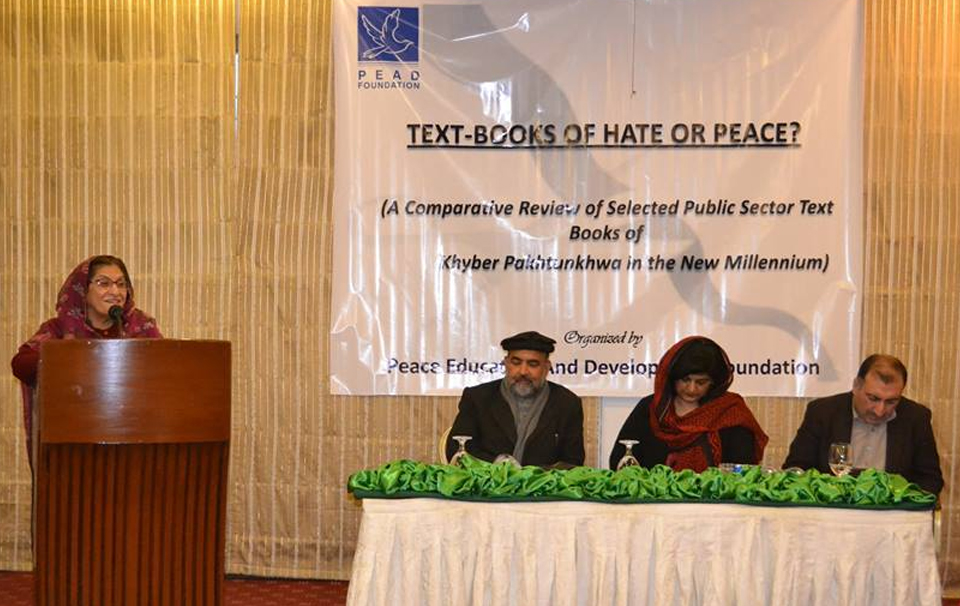
Peshawar: Launching of Textbooks of Hate or Peace? on 11 Feb 2016

By Zubeida Mustafa

PAULO Freire, the Brazilian educator and author of Pedagogy of the Oppressed, said education should aim at teaching students to think critically. They should work with the teacher in creating knowledge.

Freire believed that students should do a lot of “problem-posing” and then seek answers through their own experience and thought processes to discover the route to change.

Can we hope to achieve this change through the kind of textbooks used in our public-sector schools? For decades, critics have mourned the dismal state of textbooks in Pakistan. But no one has batted an eyelid. Continue reading Textbooks of hate