Category Archives: Islamisation

Keeping them illiterate

By Zubeida Mustafa

Going by the number of education policies announced in Pakistan since 1947, the volume of reports produced by commissions on this issue of direct concern to human development and the statements issued by government dignitaries pledging their commitment to universalising education, one would have thought that by now  Pakistan must be heading the world  education league.

What is the reality? The UNDP, which compiles the Human Development Index using schooling as one of the criteria, tells us another story. In its 2015 report, Pakistan is categorised as a Low Human Development country and ranks 147th out of 188 states. The mean years of schooling for children is 4.7 years and only a third of the population above 25 has had some secondary schooling. Continue reading Keeping them illiterate
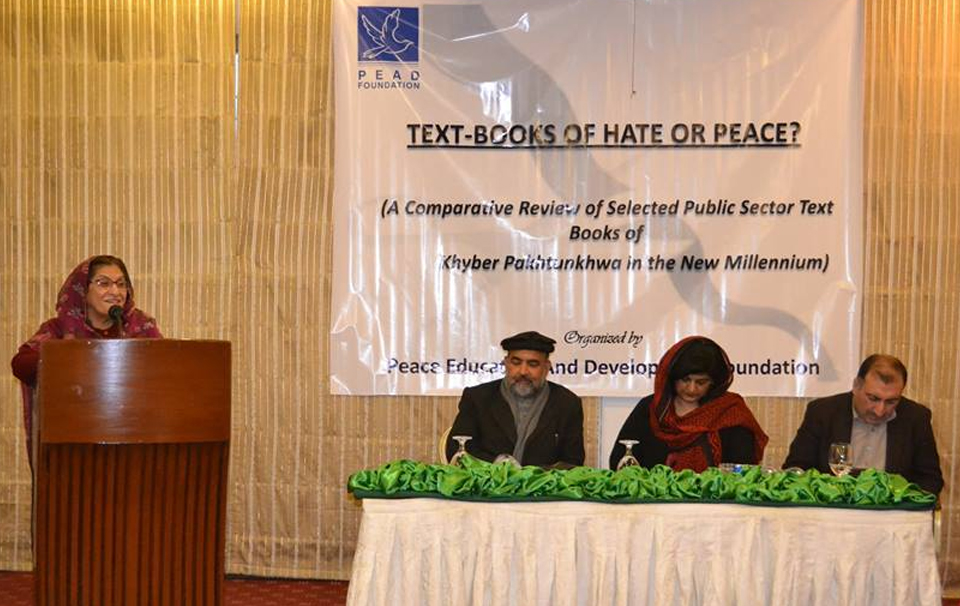
Textbooks of hate

Peshawar: Launching of Textbooks of Hate or Peace? on 11 Feb 2016

By Zubeida Mustafa

PAULO Freire, the Brazilian educator and author of Pedagogy of the Oppressed, said education should aim at teaching students to think critically. They should work with the teacher in creating knowledge.

Freire believed that students should do a lot of “problem-posing” and then seek answers through their own experience and thought processes to discover the route to change.

Can we hope to achieve this change through the kind of textbooks used in our public-sector schools? For decades, critics have mourned the dismal state of textbooks in Pakistan. But no one has batted an eyelid. Continue reading Textbooks of hate

An erratic coalition

By Rifaat Hamid Ghani

geust-contPakistan has done many stupid things within the rubrics of foreign and domestic policy. And joining a coalition of predominantly Arab states against ‘terrorism’ where the terrorist and the nature of the activity are defined ad lib could prove one of the most regrettable. There is such a thing as rational neutrality, but it seems to be something with which we are non-aligned.

Of course we are financially indebted to Saudi Arabia (the coalition’s convener) more recently and currently than we are indebted to Iran: But that could also be because Iran has been sanctioned out of prosperity; rather the way Saddam’s Iraq was. And the coalition’s focus is on Iran and Shi’ite ‘insurrectionary’ segments or regimes Iran may be sympathising with in the very troubled Middle East and Gulf states. Iran has never taken a side that is overtly or covertly hostile to Pakistan or vice versa. Are we coalescing to create adversaries for ourselves and foster sectarian differentiations? Continue reading An erratic coalition

Magic of science

By Zubeida Mustafa

Lalah Rukh Malik - Photo by Khaula
Lalah Rukh Malik – Photo by Khaula Jamil

SOMETIME ago, I was trying to teach Shaan, a teenager studying in a school in a low-income neighbourhood, about the rotation of the earth, the solar eclipse and the pull of gravity. After describing these phenomena, I asked him why we didn’t fall off the earth when it rotates. He very promptly replied, “Because God has willed it so.”

His lack of curiosity about natural phenomena left me thunderstruck. Then a look at the science textbooks used in our schools gave me a better insight into the disinterest of our students in science. They are required to memorise a Continue reading Magic of science

Peace women

By Zubeida Mustafa

THE Tehreek-i-Niswan and Sheema Kermani have always been at the forefront when matters of peace are at stake. Many performances by the Tehreek have been directed at protesting the brutality of violence against and oppression of women. Hence it was quite in keeping with its character that the group convened a ‘peace table’ on Oct 15, at the Karachi Arts Council. Here hundreds of women and also men assembled to reinforce the widely held, but unimplemented, belief that female involvement in peacemaking improves the chances of lasting security.

A landmark resolution (1325) was adopted by the UN Security Council 15 years ago calling for women to be included in decision-making positions at every level of peacemaking. It has so far made a nominal impact. The head of UN Women, Phumzile Mlambo-Ngcuka, admits that globally “women’s participation at peace tables is still symbolic or low”. Continue reading Peace women