Category Archives: Women

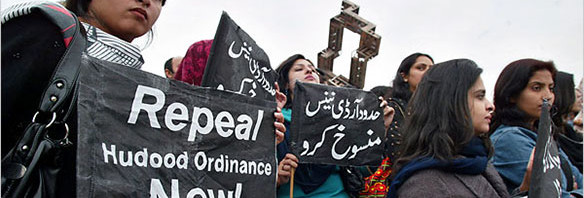
How the women of Pakistan cope with war, honor killing and prejudice

By Zubeida Mustafa

How do women cope in Pakistan? This is a question I am very frequently asked by people in the West who are flooded by news of all the incessant outrageous happenings in my country. One cannot deny that in times of crisis that have global bearings—as in the Afghan war of the 1980s and the post-9/11 years—Pakistan receives more than its share of publicity in the international media. Regrettably, most of it is negative. And quite a lot of it is also true.

However, like the proverbial half-empty or half-full glass, the impression one forms depends on the context in which one sees a situation. Since the reporting tends to be heavily based on received wisdom, the truth does not emerge fully. As a result, only the bad news of the half-empty glass is reported, which reinforces the fears of skeptics: The fires of violence in Pakistan will engulf the world and destroy it. But there is no mention of the half-full glass that gives many of us hope. Continue reading How the women of Pakistan cope with war, honor killing and prejudice

Human side of jobs

By Zubeida Mustafa

A MAJOR challenge faced by Pakistan’s economy today is one of providing opportunities for income generation to the fast-growing manpower. With the country’s population escalating at the rate of 2 per cent per annum and three million young people coming of age every year the first priority is obviously job creation. But barely 700,000 new jobs are generated annually.

According to statistics given by Michael Kugelman of the Woodrow Wilson International Centre, Washington, this has led to a massive exodus of young people to cities and this has caused rapid urbanisation in the country which, in turn, has created difficulties of its own. Continue reading Human side of jobs

A silent revolution

By Zubeida Mustafa

HOW does one profile a woman who has the academic qualifications and 19-year work experience of a financial journalist, but is not attracted by the aura of glamour many lesser media people like to create around themselves? Her commitment lies with the rural community in her ancestral village in Sindh but she modestly refuses to describe herself as an expert in development work. “I am still learning on the job,” she tells me.

Meet Naween A. Mangi, the Pakistan Bureau Chief of the New York based Bloomberg News since 2006. She may be a novice – albeit a devoted one – in development but in financial journalism her expertise and experience are unmatched. She has the intricacies of the stock market at her finger tips and is well-versed in the ups and downs in the corporate sector in the country. She works diligently planning coverage, filing important stories when she is required to and training and managing younger journalists, a job she excels in by virtue of her considerable experience in launching news organizations, working on the lay-out and injecting new ideas in old publications.
Continue reading A silent revolution

Language Discrimination in Pakistan Harms Women and Indigenous Culture

By Zubeida Mustafa

Asifa, 12, lives in Karachi, the port city in southern Pakistan. She is a child of the lesser gods. That means that she is malnourished and falls ill frequently. Her home is a modest two-room house with no running water in which her family of eight lives. She is fortunate to go to a better school than the public sector institutions many of her friends and neighbors attend – that is, if they go to school at all. Being the first generation school-goer in her family, Asifa’s is not the carefree existence a child deserves. Her parents have invested a lot in her to provide her education, and have pinned all their hopes in her future.

Will Asifa be able to lead her family out of poverty? Most unlikely. Continue reading Language Discrimination in Pakistan Harms Women and Indigenous Culture

Revisiting the Women’s Movement

By Zubeida Mustafa

PAKISTAN is a dichotomous world. This is a country that has produced a woman prime minister – the first to be elected in a Muslim state. Its predominantly male parliament – the lower house – unanimously adopted a bill against domestic violence four years ago, but it failed to become law because the upper house refused to take it up. Its academia are now overflowing with female students – many of them in hijab. But this is also a country where women are murdered for marrying a man of their own choice, where little girls like Malala are shot in the head for going to school and where law makers defend their ‘right’ to bury women alive in the name of honour and refuse to condemn a colleague who has had his daughter killed for wanting a divorce. Continue reading Revisiting the Women’s Movement