No child’s play

By Zubeida Mustafa

FOUZIA is 13 and is employed by a working mother of two children. Fouzia is the victim of oppression on three counts. She performs the duties of an adult woman, which would be classified as child labour. She is not attending school as is compulsory for children from five to 16 years of age under Article 25-A of the Constitution.

Above all, she will soon be another example of early marriage as she is said to be engaged. The wedding will take place as soon as she has earned enough for her dowry. In the process, Fouzia has been robbed of her childhood and an education.

These deprivations do not bother this young girl’s family. Their sociocultural norms and, according to many, poverty have landed her in this ugly situation. According to Unesco, from 1987 to 2005, early marriage was the fate of nearly 32 per cent of all children in Pakistan. Continue reading No child’s play

Creeping changes

By Zubeida Mustafa

A SILENT language revolution is changing the face of Pakistan in the public discourse. There was a time when proceedings in most dialogues were conducted in English. As could be expected, the message conveyed by the speakers would not get across to the entire audience.

Mercifully, things have begun to change. Bilingualism is the order of the day with greater weightage being given to indigenous languages. Those who really want to communicate with the audience — politicians and the electronic media — are aware that they would have few takers if they were to speak in English as not many understand the nuances of this foreign language and even fewer can speak it. This acknowledgment of the reality is a positive development, especially when we claim to be a democracy. Continue reading Creeping changes

Candle of hope

Dr Ruth Pfau: Photo by Dr Salamat Kamal

By Zubeida Mustafa

WHEN you start to despair — and we have too many occasions for that — go get the light of hope from someone who holds the candle. So I went to see Dr Ruth Pfau, who has been an inspiration for many, especially the most stigmatised of segments — her leprosy patients.

Even in her poor state of health in her hospital bed, Dr Pfau continues to be the candle of hope she has epitomised. She was hospitalised recently but is now in her own apartment in her neat and prim clinic. Of course, she is happy to be back home, she told me.

As I held her hand I could feel the “enrichment flow from her into me” to use her words. That is the role she has been playing since she arrived as a young woman of 31 in Karachi from Germany in 1960 and made Pakistan her home. It was chance that took her to the Lepers’ Colony behind the commercial offices on McLeod Road (now I.I. Chundrigar Road). The squalor and subhuman conditions did not deter her. Within three years, she had set up a proper leprosy clinic, now an eight-storey hospital on Shahrah-i-Liaquat, and the hub of 157 leprosy centres all over the country. There followed an arduous journey of over five decades devoted to “serving the unserved”. At no stage has her commitment slackened. Continue reading Candle of hope

Short-cuts to writing?

By Zubeida Mustafa

We Pakistanis are very ingenious and resourceful when it comes to solving seemingly intractable issues. We manage to “invent” solutions for every problem we face – and there is no shortage of those.

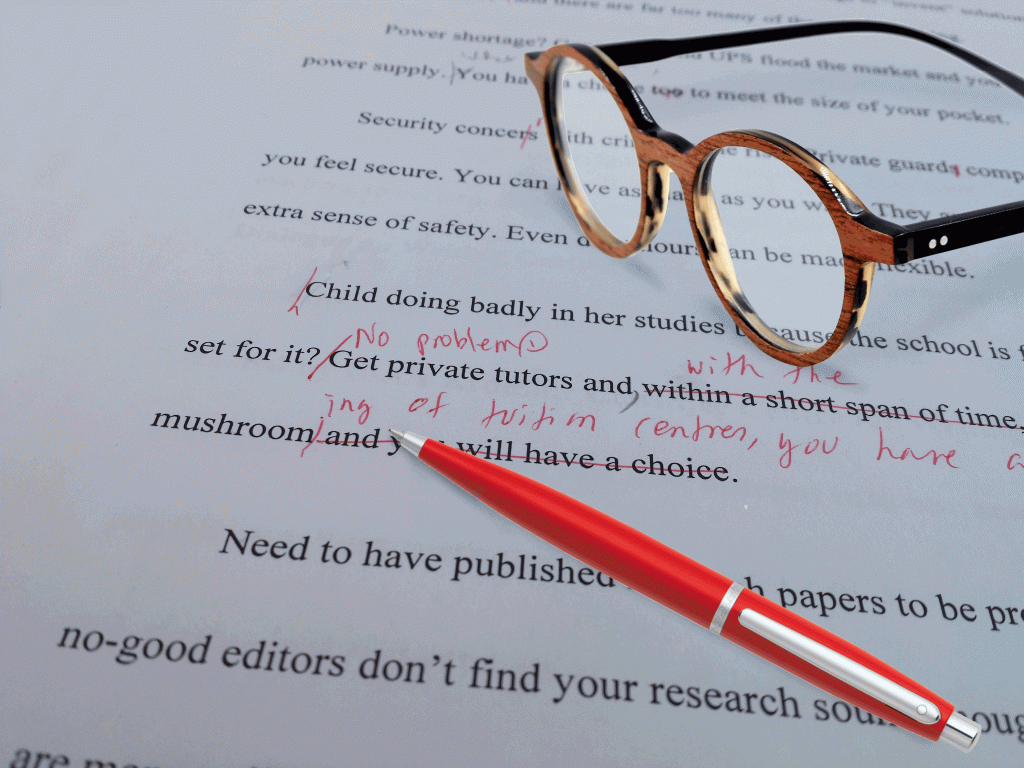
Power shortage? Generators and UPS’ flood the market and, presto, you have your own power supply. What’s more, you have a choice to meet the size of your pocket.

Security concerns with crime on the rise? Private security companies can provide guards on demand and, depending on your budget, you can have as many as you want. They are also armed to give you an extra sense of safety. Continue reading Short-cuts to writing?

Where the ill lies

By Zubeida Mustafa

“THERE has been an enormous overproduction of uneducated and ill-trained medical practitioners … due to the existence of a very large number of commercial (medical) schools … which are profitable business.”

Does the above refer to Pakistan? It doesn’t but it could as it is an apt description of the conditions prevailing in the country. The words above are from Abraham Flexner’s 1910 report on the state of medical education in North America. It led to the closing down of 124 of the 155 medical schools operating in the US and Canada at the time. Continue reading Where the ill lies