Category Archives: Constitution

Wanted: truer democracy

By Rifaat Hamid Ghani

geust-contLOCALLY  we are hearing rather a lot about what PMs in truer democracies than ours did after getting not-so-honourable mentions in PanamaLeaks. In Greenland (or was it Iceland? Do a Google) the impugned prime minister resigned.  In that hallowed parliamentary prototype Great Britain, the PM’s public and parliamentary response after a Panama reference to family embarrassed him has been exemplary, as Nawaz Sharif’s challengers love to remind. Maybe our PM has other role models. Our Youth Bulge electoral segment may not know that even before the internet, in Great Britain’s truly salubrious democratic clime, the Iron Lady’s Dennis was not allowed to menace once the veil was lifted on his delinquencies. He went right off the island if not offshore (Mummy stayed in office). Continue reading Wanted: truer democracy

Change: at all costs?

By Rifaat Hamid Ghani

guest-contributorIT is time we stopped taking the easier choice of setting out to scrap a faulty political setup and system and focused on laboring to better it: That means allowing it to function and, in that very process, rectifying its deficiencies. For what is the innovative alternative?

We have tried both parliamentary and presidential democratic modes. We have undergone four varieties of military dictatorship. We have framed and discarded more than one constitution. We have journeyed from centralising West Pakistan’s provinces into one unit, into the mysterious provincial autonomy of the Eighteenth Amendment to the 1973 constitution. Continue reading Change: at all costs?

Keeping them illiterate

By Zubeida Mustafa

Going by the number of education policies announced in Pakistan since 1947, the volume of reports produced by commissions on this issue of direct concern to human development and the statements issued by government dignitaries pledging their commitment to universalising education, one would have thought that by now  Pakistan must be heading the world  education league.

What is the reality? The UNDP, which compiles the Human Development Index using schooling as one of the criteria, tells us another story. In its 2015 report, Pakistan is categorised as a Low Human Development country and ranks 147th out of 188 states. The mean years of schooling for children is 4.7 years and only a third of the population above 25 has had some secondary schooling. Continue reading Keeping them illiterate

Textbooks of hate

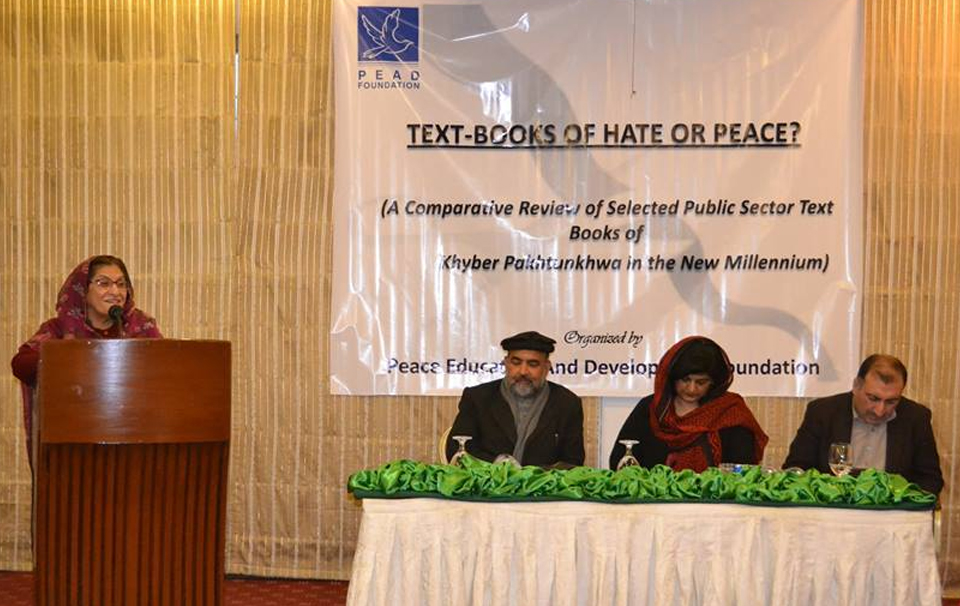
Peshawar: Launching of Textbooks of Hate or Peace? on 11 Feb 2016

By Zubeida Mustafa

PAULO Freire, the Brazilian educator and author of Pedagogy of the Oppressed, said education should aim at teaching students to think critically. They should work with the teacher in creating knowledge.

Freire believed that students should do a lot of “problem-posing” and then seek answers through their own experience and thought processes to discover the route to change.

Can we hope to achieve this change through the kind of textbooks used in our public-sector schools? For decades, critics have mourned the dismal state of textbooks in Pakistan. But no one has batted an eyelid. Continue reading Textbooks of hate

A Global Conglomerate of Oppression

Noor Zaheer

By

The pronounced lack of interest in the public health system in Pakistan is not difficult to explain. Public opinion in a country as stratified and uninformed as ours, is created and moulded by the so-called privileged classes, comprising those members of society who have the means to pay for private health care. Hence they are not affected by the abysmal state of health care in the public sector on which the poor depend.

The general attitude is: what is the role of the poor in our society? They are useful only for domestic labour in the homes of the rich or for menial work in public places and factories. And, of course, to vote at election time. A higher birth rate among the impoverished ensures there is never any shortage in the labour force. If they fall sick, they are easily replaced. With limited skills and training, none are really indispensable. Continue reading A Global Conglomerate of Oppression